Monday, January 26, 2015
Mission Celebration: Inviting Participation
Too often a mission event doesn't invite prayer and participation of those involved. The mission of God should be the primary agenda of everyone in a church. Plus make it a way of welcoming your community into this most transformational, servant oriented work. Notice with the "ask" for participation that a church can emphasize priorities with both short term and long term impact. I love the sign because on first glimpse I think of the visiting partner missionaries, but when I think about it further the fact is that EVERY Christian is called to be a missionary, a messenger by word and deed, of the work of God through Jesus Christ and His followers. Here are some great examples from Norcross FUMC:
Thursday, January 22, 2015
Video of GBGM Welcome Service
Here's a video of the January 8, 2015 worship service as we welcomed the UMC's General Board of Global Ministries to Georgia at Grace UMC.
Wednesday, January 21, 2015
Next Church, Community Centers, & Circuits
I'm learning a lot about churches and communities all over North Georgia. There are 930 United Methodist churches in the North Georgia Conference, so I'm getting in plenty of travel and deeper immersion into communities.
Every day offers incredible conversations and discovery in this adventure serving on Connectional Ministries as a resource to the laity and clergy of our NGUMC congregations. Our role in equipping, resourcing, and leadership development offers the chance to "go deeper" in knowing the church and how we can best help one another in the good work.
Recently I've had some of the usual conversations about a new vision and approach to mission that helps the church connect in deep ways to the community. I've also had some exciting dialogue around the "Next Church," the church as community center, and circuits of churches with strong emphasis on the laity as a new/old way of doing Methodist ministry.
We are in a necessary shift in the United States as the last generation/s of church- think professional clergy, program driven, lots of infrastructure with buildings- gives ways to the next church. We seem to be entering a day of less funding available for churches, a tougher context in a more secular world, and a need to be flexible in how we create models of church which aren't overly dependent on what worked in program and style for the last generation thinking if we work harder this generation will learn to love it.
I certainly don't mean we'll do away with worship, discipleship, outreach (evangelism and outreach) as there are elements of Christian community which work in every age and place. But the style needs to adjust to what works today even as the substance of Christianity remains the same.
This will call for some experimentation a we create Next Church. It is vital we attempt styles of ministry and church that engages the under 40 age group. Authentic, honest, and real will carry this day. It is necessary for both denomination and congregation that we are better connected so that various age level ministries, college and campus ministries, clergy training, and the variety of agencies and units are all working with similar agendas. Though we'll come at it from various perspectives a primary driver must be engaging and incorporating new brothers and sisters into the life of the church. Too often, both in a church and larger grouping of churches, we've been disjointed, out of step with one another, and tended toward silo approaches. The beauty of a dovetail joint in woodworking is the image that comes to mind as I think of the Next Church. There is a simplicity, elegance, and power with a dovetail joint as single elements are combined together to make something useful.
We need to return to authentic evangelism that engages our communities into the life of the church in ways that bring life to all involved. We need to equip and deploy clergy in ways that work well. We need to build the Next Church which is true to our roots, yet enables us to be on all the frontiers we find. Some of the frontier will be a new way of being the church which may not be as large, as program driven, as clergy dependent, yet is vibrant and fruitful. It seems we can't put clergy in solo positions in congregations as we've done the past 50 years as many congregations can't afford full time clergy with all the perks. What will effective models of bivocational ministry look like for Methodists and how will we train for that and reorient the church culture around laity in witness and evangelism?
Some of my background has been with an understanding of the church being the hub of the community. In one place, we even intentionally spoke of our role as being "THE community center." Now, the intent wasn't to just have outside groups rent our space. Rather, we wanted to be "in the middle of everything" when it came to the community. And through that we wanted to build relationships, help people find their way into the life of the church, and bridge church and community.
I'm optimistic we can create these new realities as I meet so many hard working, creative United Methodists who follow Jesus. Surely, together, we can create the Next Church and not fall into the trap of yearning for "glory days" which never were and embrace a better way which God will create with us.
Every day offers incredible conversations and discovery in this adventure serving on Connectional Ministries as a resource to the laity and clergy of our NGUMC congregations. Our role in equipping, resourcing, and leadership development offers the chance to "go deeper" in knowing the church and how we can best help one another in the good work.
Recently I've had some of the usual conversations about a new vision and approach to mission that helps the church connect in deep ways to the community. I've also had some exciting dialogue around the "Next Church," the church as community center, and circuits of churches with strong emphasis on the laity as a new/old way of doing Methodist ministry.
We are in a necessary shift in the United States as the last generation/s of church- think professional clergy, program driven, lots of infrastructure with buildings- gives ways to the next church. We seem to be entering a day of less funding available for churches, a tougher context in a more secular world, and a need to be flexible in how we create models of church which aren't overly dependent on what worked in program and style for the last generation thinking if we work harder this generation will learn to love it.
I certainly don't mean we'll do away with worship, discipleship, outreach (evangelism and outreach) as there are elements of Christian community which work in every age and place. But the style needs to adjust to what works today even as the substance of Christianity remains the same.
This will call for some experimentation a we create Next Church. It is vital we attempt styles of ministry and church that engages the under 40 age group. Authentic, honest, and real will carry this day. It is necessary for both denomination and congregation that we are better connected so that various age level ministries, college and campus ministries, clergy training, and the variety of agencies and units are all working with similar agendas. Though we'll come at it from various perspectives a primary driver must be engaging and incorporating new brothers and sisters into the life of the church. Too often, both in a church and larger grouping of churches, we've been disjointed, out of step with one another, and tended toward silo approaches. The beauty of a dovetail joint in woodworking is the image that comes to mind as I think of the Next Church. There is a simplicity, elegance, and power with a dovetail joint as single elements are combined together to make something useful.
We need to return to authentic evangelism that engages our communities into the life of the church in ways that bring life to all involved. We need to equip and deploy clergy in ways that work well. We need to build the Next Church which is true to our roots, yet enables us to be on all the frontiers we find. Some of the frontier will be a new way of being the church which may not be as large, as program driven, as clergy dependent, yet is vibrant and fruitful. It seems we can't put clergy in solo positions in congregations as we've done the past 50 years as many congregations can't afford full time clergy with all the perks. What will effective models of bivocational ministry look like for Methodists and how will we train for that and reorient the church culture around laity in witness and evangelism?
Some of my background has been with an understanding of the church being the hub of the community. In one place, we even intentionally spoke of our role as being "THE community center." Now, the intent wasn't to just have outside groups rent our space. Rather, we wanted to be "in the middle of everything" when it came to the community. And through that we wanted to build relationships, help people find their way into the life of the church, and bridge church and community.
I'm optimistic we can create these new realities as I meet so many hard working, creative United Methodists who follow Jesus. Surely, together, we can create the Next Church and not fall into the trap of yearning for "glory days" which never were and embrace a better way which God will create with us.
Tuesday, January 20, 2015
Mission Celebration: Global Banners
Rev. Debra Tyree did a masterful job of creating banners out of a bunch of fabric we collected for the recent GBGM Welcome in Atlanta. Check out how to do it for your event! See http://www.umcmission.org/learn-about-us/news-and-stories/2015/january/0120prayingwiththeworld for the details.
Resilent Ecology and the Adaptive Church
The problem for many congregations and denominations is that we don't like change and we aren't very adaptive to current realities. We prefer our routine, nostalgia over assessment, what makes me feel good about church versus what works to integrate the next generation deeply in the life of church. We love "our" tradition, the "last chapter" of the life of the church, and may have an unwillingness or inability to respond to change or create a new chapter of life. We probably don't talk about such things, but have a nagging suspicion that the momentum and way of life are slipping away. Or, we resign ourselves to the fact the congregation has come to the end of its life cycle, and as the current membership dies so does our beloved church.
That last statement never has made much sense to me since there are usually people left in the neighborhood even after the last church member is buried.
So, how does a church find a new life cycle as it successfully adds more children of God to the family of faith known as a congregation?
I enjoy gardening and nature, so I often think of the church and community as an ecological system. This is an interesting exercise as you can think about all the elements that create a growing, self sustaining, vibrant system. The seasons, soil, sun, air, water, and interrelationship of these elements, and all the inhabitants of a particular ecology, are connected and create a world within the world. Of course, there are often negative impacts upon an ecosystem. These change factors - they could be caused by nature (i.e. flood or fire) or humans (i.e. deforestation or "development") - can radically intrude upon the system. Or, if there is a significant change in a particular element in the system it can create an imbalance that restructures everything.
An intriguing element of this is resilience and adaptation by an ecological system. Again, I'm thinking about this in terms of the church. Now, if you are an ecologist this Wikipedia snippet may not be satisfying, but for many of us it does make the concept understandable.
How resilient is your congregation? Have you crossed a threshold, or are nearing a crucial point for the church, from which there is no return? How aware is the congregation of the threshold, or is this an intuitive issue which no one has assessed or spoken about formally? If you were to rate your precariousness on a scale of 1-10, with 10 meaning you are at a tipping point, how is your church? How resistant to change is the congregation? Are you resistant to God? one another? your neighborhood? other factors? Panarchy deals with the complexity of interactions and relationship within a system, with the appropriate tension and balance between stability and change, and the ways that is managed. It's not about single equilibrium, but multiple equilibria. Is your church overwhelmed and totally out of balance? How might you adapt to the change/s and find equilibrium that allows for stability and change?
Recall what Jesus said in John 15:1-2, "I am the true vine, and my Father is the gardener. He cuts off every branch in me that bears no fruit, while every branch that does bear fruit he prunes so that it will be even more fruitful." Yet, while this should be expected for an individual and a church it is still challenging when it is a subjective reality and someone is asking you to be objective in the face of change. Yet, it is a reality of life and faith. Perhaps resilient ecology can be a help to the adaptive Christian and Church.
That last statement never has made much sense to me since there are usually people left in the neighborhood even after the last church member is buried.
So, how does a church find a new life cycle as it successfully adds more children of God to the family of faith known as a congregation?
I enjoy gardening and nature, so I often think of the church and community as an ecological system. This is an interesting exercise as you can think about all the elements that create a growing, self sustaining, vibrant system. The seasons, soil, sun, air, water, and interrelationship of these elements, and all the inhabitants of a particular ecology, are connected and create a world within the world. Of course, there are often negative impacts upon an ecosystem. These change factors - they could be caused by nature (i.e. flood or fire) or humans (i.e. deforestation or "development") - can radically intrude upon the system. Or, if there is a significant change in a particular element in the system it can create an imbalance that restructures everything.
An intriguing element of this is resilience and adaptation by an ecological system. Again, I'm thinking about this in terms of the church. Now, if you are an ecologist this Wikipedia snippet may not be satisfying, but for many of us it does make the concept understandable.
Consider the ecology of a congregation, a district or conference, an agency, or an entire denomination. Think about the possibilities in the garden as opportunities given all the dynamic factors rather than a stable, closed system that has a set trajectory and is destined to play out "as is."Ecologists Brian Walker, C S Holling and others describe four critical aspects of resilience: latitude, resistance, precariousness, and panarchy.The first three can apply both to a whole system or the sub-systems that make it up.
- Latitude: the maximum amount a system can be changed before losing its ability to recover (before crossing a threshold which, if breached, makes recovery difficult or impossible).
- Resistance: the ease or difficulty of changing the system; how “resistant” it is to being changed.
- Precariousness: how close the current state of the system is to a limit or “threshold.”.[4]
- Panarchy: the degree to which a certain hierarchical level of an ecosystem is influenced by other levels. For example, organisms living in communities that are in isolation from one another may be organized differently from the same type of organism living in a large continuous population, thus the community-level structure is influenced by population-level interactions.
How resilient is your congregation? Have you crossed a threshold, or are nearing a crucial point for the church, from which there is no return? How aware is the congregation of the threshold, or is this an intuitive issue which no one has assessed or spoken about formally? If you were to rate your precariousness on a scale of 1-10, with 10 meaning you are at a tipping point, how is your church? How resistant to change is the congregation? Are you resistant to God? one another? your neighborhood? other factors? Panarchy deals with the complexity of interactions and relationship within a system, with the appropriate tension and balance between stability and change, and the ways that is managed. It's not about single equilibrium, but multiple equilibria. Is your church overwhelmed and totally out of balance? How might you adapt to the change/s and find equilibrium that allows for stability and change?
Recall what Jesus said in John 15:1-2, "I am the true vine, and my Father is the gardener. He cuts off every branch in me that bears no fruit, while every branch that does bear fruit he prunes so that it will be even more fruitful." Yet, while this should be expected for an individual and a church it is still challenging when it is a subjective reality and someone is asking you to be objective in the face of change. Yet, it is a reality of life and faith. Perhaps resilient ecology can be a help to the adaptive Christian and Church.
Friday, January 16, 2015
Worship Marks Beginning of GBGM Transition to Grace UMC/Atlanta
Here's the North Georgia UMC news story on the General Board of Global Ministries Welcome last Sunday night as we celebrated in Worship.
Monday, January 12, 2015
Welcome of GBGM at Grace UMC
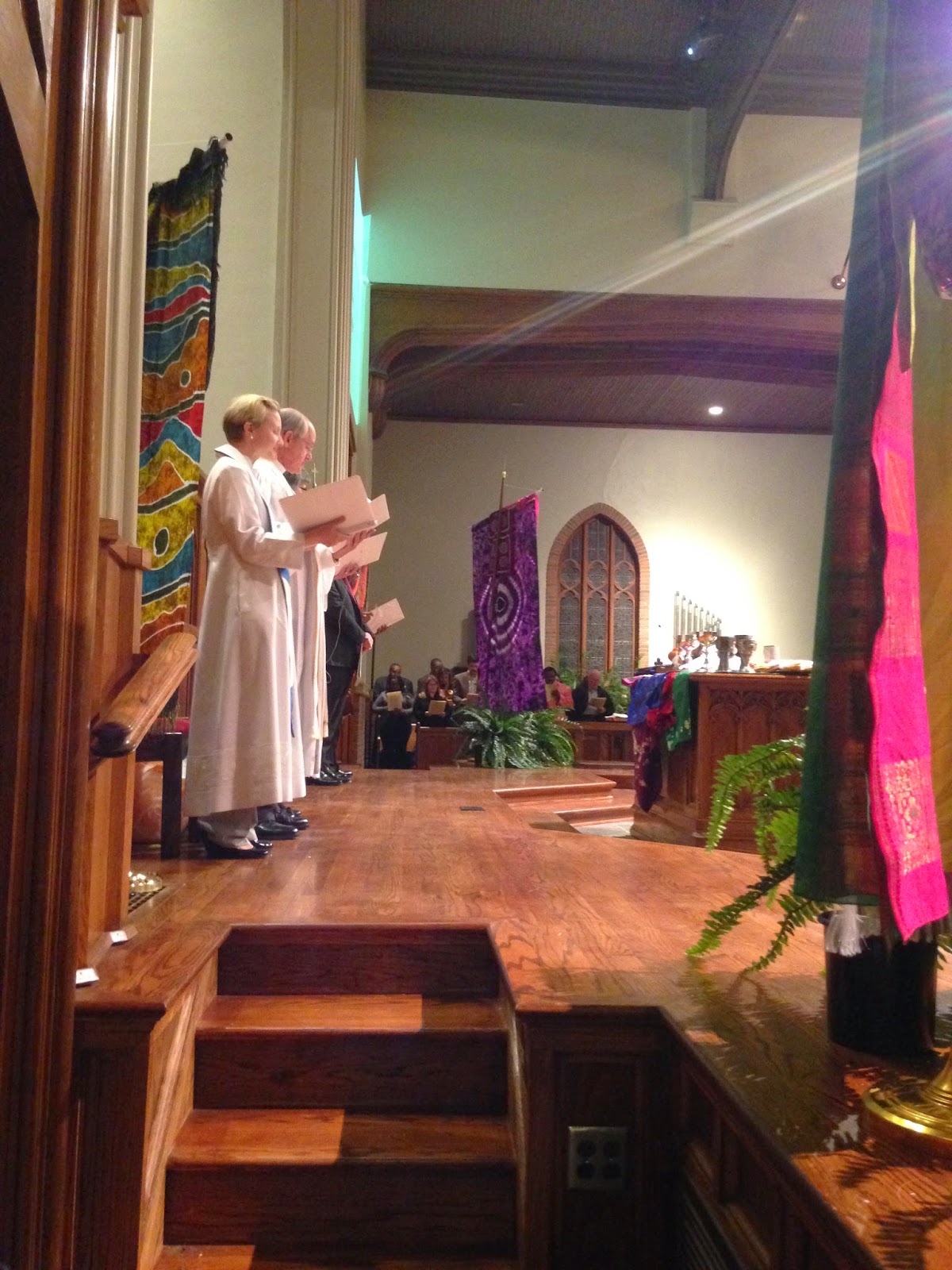
Enjoy a few of my "behind the scenes" photos from the incredible worship yesterday as North Georgia and South Georgia Conferences of The United Methodist Church welcomed our denomination's General Board of Global Ministries to Atlanta!
Saturday, January 10, 2015
Mission Celebration: Recognizing Volunteers
Ok, I struggle with what to call volunteers, servants, church workers, Christ followers, etc.
What I do know is that is the crowd I most enjoy spending time with as they live out the following of Christ in ways that engage me and encourage me. These folk are the active workers in the Kingdom of God who "flesh out" serving in the way of Christ inspire and renew the Church as they demonstrate the power of the Holy Spirit at work. They incarnate the continued ministry of Christ who heals, feeds, and comforts people even today.
I'm at Dalton First UMC attending their annual Global Impact Celebration. Rev. Kenny Ott and his mission team did a great job with this fun night. This year the focus is on leadership. On Saturday night they had a dinner and focus on volunteers in the congregation who were nominated by church members for their service. They called it "Night With the Stars."
These are the folk who put their faith into action.
Funny thing is most of these folk don't want to be honored or have a spotlight on them.
But they did enjoy the party!
Funny thing is most of these folk don't want to be honored or have a spotlight on them.
But they did enjoy the party!
Mission Celebration: Best Practices
I'm at Dalton First UMC today enjoying their Global Impact Celebration. The theme this year is on leadership in the church. The power of this is that it allows for deep connection to the biblical and theological foundation of what it means to be a Christian, the Church, and a leader in those arenas. This ties together all of life and church, and offers a sharp focus. You might wisely consider "leadership" as a theme for your mission event or workshop.
Friday, January 9, 2015
Mission Celebrations as a Church Strategy
I have found that an annual Mission Celebration can be a powerful way to conclude a a year of service and launch into a new year of outreach. Don't think of a Mission Celebration as "just" an event, but play with the concept as a mission launch for your church.
It is an ideal time to give thanks to God and church members for what has occurred as you've shared together in mission in the past year. It is the perfect time to "spice up" church life as you hear the call again to God's mission as shown to us in Christ. A Mission Celebration is the occasion we can listen to the Spirit for the needs today in Church and Community as we respond to what is required of us today and tomorrow.
Such events may be called Mission Celebrations, Outreach Celebrations, Global Impact Celebrations, or whatever you wish. The emphasis isn't so much about the title, but about how you can most effectively engage your congregation in God's mission. This is the time to educate and inspire and serve. This is a way of challenging every member to be part of the team as you need everyone to pray and learn, to go and receive, to fund, and most importantly to grow deeper in their love of God and love of neighbor. This is a powerful way to help individuals, families, and church take the next steps of faith in Christ in practical, lived out ways. This is a rallying point for the entire church to be about the transformational work we are called to in the Kingdom of God.
The concept can be readily adapted to your congregation and context. I've seen Mission Celebrations which are one day events, weekend events, or multiple days in length. In my personal experience we found that the church responded well to having a celebratory emphasis which expressed gratitude for what had been accomplished. The necessary second part, and emphasis which launched us into the "next steps," included a strong Challenge component which gave focus and direction and had strong call for participation. The key is what will engage your people and launch them into mission.
We learned that my congregation appreciated a Service Day, a Training Day, and then a Challenge Day. With each of these we would craft the event in ways that allowed for some variety over the years so that we didn't offer dull, boring, routine. We would have our MC in the winter and found it to be a great, anticipated annual event. Sometimes the MC might offer a mix of local, national, and international mission. Sometimes we might focus more specifically on a particular geographic area of of mission or on a powerful theme, e.g. you could focus on local or focus on the issue of hunger in all of the regions. We would always seek to use mission partners in this (either established partners or new ones or a mix) and to emphasize those primary outreach alliances and our role as a church as an engaged partner.
The Service Day would be the chance to get everyone "hands on" involved into outreach serving those outside the church. Again this would emphasize partners, and those organizations which complement the church mission partners, as we involve the members in mission.
Often we would try for a mix of impact ranging from local to national to international. We would also intentionally create a variety that might involve children, teens, and adults.
The focus is how do we help church and community take the next step in service? This also allowed us to involve community members who are looking to the church as a leader in service.
As church leaders plan it's often helpful to read the Scriptures again and consider the ministry of Jesus. How do we help every church member care for orphans and widows, know the prisoner and the poor, walk in neighborhoods and into lives that Jesus would frequent.
The Training Day is a chance to share missionary updates, to do training or certification, or to delve deeper into conversations on the big topics of our neighborhoods or mission. Possibilities for training are diverse and could include:
The Challenge Day would always be an exciting conclusion to the Mission Celebration which would end with powerful worship and a call to every member to respond to God's call to mission. Let me again say that the call of God's Mission is to every person in attendance. Some models could have a Sunday morning worship and a Sunday night worship, so that you could separate elements of the challenge to the congregation. In my church setting, we found it most effective to have Sunday morning as the dramatic conclusion which engaged the most members. We would offer the strong call to for mission prayers, participation, and funding for everyone. In my setting the finance committee had done away with multiple Sundays throughout the year for "special asking" of funds and built it all into one Sunday. Different churches will do the funding of mission in various ways, but we found this worked well in this particular congregation. Do note we would continue to talk about mission, have updates, and continue the stories of mission throughout the year; we just wouldn't ask for money for mission at other times. Again, the important issue is how will you advance mission in your congregation.
As we concluded our Mission Celebration we expected the worship to help launch us into a new year of following Christ in service. The music, the sermon, and the call to response was all built around every person taking their next step of faith in Christ and sharing their prayers, participation, and funds for the year of outreach ahead.
Consider a Mission Celebration as a way to elevate your church in God's Mission. I'd be glad to help you in the effort as we all take those next steps of faith as we follow the way of Christ in service.
It is an ideal time to give thanks to God and church members for what has occurred as you've shared together in mission in the past year. It is the perfect time to "spice up" church life as you hear the call again to God's mission as shown to us in Christ. A Mission Celebration is the occasion we can listen to the Spirit for the needs today in Church and Community as we respond to what is required of us today and tomorrow.
Such events may be called Mission Celebrations, Outreach Celebrations, Global Impact Celebrations, or whatever you wish. The emphasis isn't so much about the title, but about how you can most effectively engage your congregation in God's mission. This is the time to educate and inspire and serve. This is a way of challenging every member to be part of the team as you need everyone to pray and learn, to go and receive, to fund, and most importantly to grow deeper in their love of God and love of neighbor. This is a powerful way to help individuals, families, and church take the next steps of faith in Christ in practical, lived out ways. This is a rallying point for the entire church to be about the transformational work we are called to in the Kingdom of God.
The concept can be readily adapted to your congregation and context. I've seen Mission Celebrations which are one day events, weekend events, or multiple days in length. In my personal experience we found that the church responded well to having a celebratory emphasis which expressed gratitude for what had been accomplished. The necessary second part, and emphasis which launched us into the "next steps," included a strong Challenge component which gave focus and direction and had strong call for participation. The key is what will engage your people and launch them into mission.
We learned that my congregation appreciated a Service Day, a Training Day, and then a Challenge Day. With each of these we would craft the event in ways that allowed for some variety over the years so that we didn't offer dull, boring, routine. We would have our MC in the winter and found it to be a great, anticipated annual event. Sometimes the MC might offer a mix of local, national, and international mission. Sometimes we might focus more specifically on a particular geographic area of of mission or on a powerful theme, e.g. you could focus on local or focus on the issue of hunger in all of the regions. We would always seek to use mission partners in this (either established partners or new ones or a mix) and to emphasize those primary outreach alliances and our role as a church as an engaged partner.
The Service Day would be the chance to get everyone "hands on" involved into outreach serving those outside the church. Again this would emphasize partners, and those organizations which complement the church mission partners, as we involve the members in mission.Often we would try for a mix of impact ranging from local to national to international. We would also intentionally create a variety that might involve children, teens, and adults.
The focus is how do we help church and community take the next step in service? This also allowed us to involve community members who are looking to the church as a leader in service.
As church leaders plan it's often helpful to read the Scriptures again and consider the ministry of Jesus. How do we help every church member care for orphans and widows, know the prisoner and the poor, walk in neighborhoods and into lives that Jesus would frequent.
The Training Day is a chance to share missionary updates, to do training or certification, or to delve deeper into conversations on the big topics of our neighborhoods or mission. Possibilities for training are diverse and could include:
- Mission as Relationship: The New Day of Mission and What That Means
- Mission Is a Call of Every Christian
- Biblical and theological foundation of mission
- "Best Practices" in Mission
- UMCOR and UMVIM mission team leader and participant training
- International mission emphasis- choose a country or topic
- "Toxic Charity" and what you might do more effectively as better steps
- Missionary updates and deeper conversations
- Opportunities for short term and long term mission service
- "So You Are Called to be a Missionary"
- Mission for Teens and Young adults
- Bridges- focus could be on the "first Bridge" in your community or any number of mission partnerships
- Better Local Mission- we invited local community experts into the church to share the toughest topics and then considered ways the church could push deeper in mission
- How to Build Mission and the Church:
- Mission and Prayer: Principles for Effective Outreach
- Effective Children's Ministry and Outreach
- Music and Mission
- Effective Partnerships: 50/50 Covenant and Mutual Partnerships
- and many other options!
The Challenge Day would always be an exciting conclusion to the Mission Celebration which would end with powerful worship and a call to every member to respond to God's call to mission. Let me again say that the call of God's Mission is to every person in attendance. Some models could have a Sunday morning worship and a Sunday night worship, so that you could separate elements of the challenge to the congregation. In my church setting, we found it most effective to have Sunday morning as the dramatic conclusion which engaged the most members. We would offer the strong call to for mission prayers, participation, and funding for everyone. In my setting the finance committee had done away with multiple Sundays throughout the year for "special asking" of funds and built it all into one Sunday. Different churches will do the funding of mission in various ways, but we found this worked well in this particular congregation. Do note we would continue to talk about mission, have updates, and continue the stories of mission throughout the year; we just wouldn't ask for money for mission at other times. Again, the important issue is how will you advance mission in your congregation.As we concluded our Mission Celebration we expected the worship to help launch us into a new year of following Christ in service. The music, the sermon, and the call to response was all built around every person taking their next step of faith in Christ and sharing their prayers, participation, and funds for the year of outreach ahead.
Consider a Mission Celebration as a way to elevate your church in God's Mission. I'd be glad to help you in the effort as we all take those next steps of faith as we follow the way of Christ in service.
Subscribe to:
Posts (Atom)