Here's a photo album courtesy of Ansley Brackin from the Networking event last Friday. We had excellent speakers present 30 minute sessions on evangelism, global ministries, and racial reconciliation ministries.
Winston Worrell of World Methodist Evangelism Institute had just returned from training in Haiti and shared a holistic Methodist understanding and practice of evangelism.
Judy Chung spoke to us about the move of UMC Global Ministries to Atlanta and what is happening in the our international denomination with missionaries- short term and long term- who go from "everywhere to everywhere."
Kevin Murriel offered practical insight into ways individuals and congregations can, and should, be active in racial reconciliation in our communities (here's one interview to give you an idea).
We'll share recordings of the day in the near future. Today, I'm thinking back to last Friday, and am once again thankful! These colleagues, and friends, are exceptional presenters, and your congregation would do well to consider them to help your congregation grow stronger in ministry.
Friday, January 22, 2016


Thursday, January 14, 2016
"Recycled, Renewed" Further Thoughts
This week our North Georgia conference "Monday Morning" shared my devotion based on our recent time in the Manila area of the Philippines. We've seen a good response to the story as the various themes of "Recycled, Renewed" has stuck a chord with folk.
You can easily pair the story up with any number of Scripture if you want to use this in a devotion, class, or sermon. Romans 12:1-3 or Ephesians 5:1-2 come to mind for me. The road to Emmaus passage in Luke 24 fits the scene of walking together and Jesus who is present. The ripple impact of Christian witness and the impact of our mission and ministry is another rich element to me in my brief story with Ronnel. Whether Great Commission, or cloud of witnesses (Hebrew 12), or another passage with focus on our place in the salvation drama today, we can be inspired and renewed in our commitment to active ministry in the community.
Of course, a passage which leaps out to match the story could be from Isaiah 40:28-31(NIV)
Discussion questions might be:
You can easily pair the story up with any number of Scripture if you want to use this in a devotion, class, or sermon. Romans 12:1-3 or Ephesians 5:1-2 come to mind for me. The road to Emmaus passage in Luke 24 fits the scene of walking together and Jesus who is present. The ripple impact of Christian witness and the impact of our mission and ministry is another rich element to me in my brief story with Ronnel. Whether Great Commission, or cloud of witnesses (Hebrew 12), or another passage with focus on our place in the salvation drama today, we can be inspired and renewed in our commitment to active ministry in the community.
Of course, a passage which leaps out to match the story could be from Isaiah 40:28-31(NIV)
28 Do you not know?
Have you not heard?
The Lord is the everlasting God,
the Creator of the ends of the earth.
He will not grow tired or weary,
and his understanding no one can fathom.
29 He gives strength to the weary
and increases the power of the weak.
30 Even youths grow tired and weary,
and young men stumble and fall;
31 but those who hope in the Lord
will renew their strength.
They will soar on wings like eagles;
they will run and not grow weary,
they will walk and not be faint.
Have you not heard?
The Lord is the everlasting God,
the Creator of the ends of the earth.
He will not grow tired or weary,
and his understanding no one can fathom.
29 He gives strength to the weary
and increases the power of the weak.
30 Even youths grow tired and weary,
and young men stumble and fall;
31 but those who hope in the Lord
will renew their strength.
They will soar on wings like eagles;
they will run and not grow weary,
they will walk and not be faint.
Discussion questions might be:
- how do you as an individual, and your congregation, engage in similar outreach ministry in their own community?
- who has your church adopted in the past into the life of the congregation by meeting needs and building relationships? who are you currently getting to know and reaching?
- how are you personally being recycled and renewed today? how is your congregation being recycle and renewed today? is your congregation a community "recycling and renewing" place? If not, what would it take for your church to become known in the community as a people of life transformation?
Enjoy the experience and participation you and your congregation may have as you learn from Ronnel and the Filipino United Methodists and experience this style ministry that fits your own community.
Monday, January 11, 2016
Dream Denomination: 5 Most Important Decisions
In 2015 I began to understand more about church and Church as I lived into my appointment in conference and global ministries. I see more clearly than ever before that often we are so bound by "what was" that we don't fully live into "what is" or "what can be." A congregation, or a denomination, can live and work more in the past than in the present or future. To start the new year it is interesting to think about leaning into the new with some renewed vigor and commitment.
So, play this game with me and see if God might be able to make use of it in some way.
Let's pretend for a moment that we are creating our Dream Denomination. What would you do if you were "king" or "queen" for a day of a denomination and could make 5 major decisions? It's a Jubilee year, and the time is ripe, so you get to lead for one day in starting everything over. Being Methodist we'd want to "do no harm" and "do all the good we can do," but with the emphasis on pleasing God we might also be free to make some major changes. You only get 5 big decisions, so make them your very best!
As for me, I'd:
1) scrap the old Book of Discipline (too "last chapter" of the US church & too institutional and bureaucratic in ways that aren't helpful for a global denomination or for ) and minimize it & build it from the ground up with focus on congregation and conference around discipleship and outreach. This would be a BOD useful in any conference or church in the world and not bogged down by regional or national issues which might best be decided in that context, yet might give more on how to operate as an international church with all conferences having equal footing.
2) recognizing we are a global denomination I'd move toward strategic offices in key continents & regions and then plant all the most vital denominational agencies in one building per location. Thus, there would be healthy "cross pollination" and strategizing between leadership, discipleship/publishing/training, evangelism, mission,etc.
3) I'd get rid of lifetime episcopacy and focus on conference clergy and leadership development which empowers a Methodist movement. Said another way, the priority for limited term bishops will be in their appointed conference (let's say 90-95% of their time is in conference as we'd still want strategic regional, national, and international connnectionalism). But the priority and strategy is first and foremost in the appointed conference.
4) I'd establish a "cradle to grave" approach to discipleship and supply churches with the material and training in support of that for studies, small groups, and our hallmark UM approach. This would be an integrated, comprehensive approach which connects congregation, district, conference, denomination, agency, college & seminary, etc. Using such material/theology/approaches would be a norm as this would be "top of the line" curriculum which other denominations and traditions would use.
5) This is perhaps the toughest of these tough measures as I'd want a "redo" of our congregations! We would all launch into this next chapter of ministry with gusto as we go about the work of God. We desperately need a laity movement that has focus on sharing the love of God in the community, and thus local church leadership must be flexible, agile, and with such a concentration on God that change, and new, and different are hallmarks of the ministries. Reaching and incorporating new and different people into our congregations should be our priority and one of the most sought after practices and skill-sets of every congregation.
How about that for some big dreaming, and hoping, as I think about the very best UMC I can imagine.
If you created a 5 point plan for the church and the Church what would that look like?
I'm thinking about a Dream Denomination today and curious if there might be a path from where we are to where we need to be. I'm sure my 2016 GC delegates will make this happen to ensure I get my 5 wishes!
So, play this game with me and see if God might be able to make use of it in some way.
Let's pretend for a moment that we are creating our Dream Denomination. What would you do if you were "king" or "queen" for a day of a denomination and could make 5 major decisions? It's a Jubilee year, and the time is ripe, so you get to lead for one day in starting everything over. Being Methodist we'd want to "do no harm" and "do all the good we can do," but with the emphasis on pleasing God we might also be free to make some major changes. You only get 5 big decisions, so make them your very best!
As for me, I'd:
1) scrap the old Book of Discipline (too "last chapter" of the US church & too institutional and bureaucratic in ways that aren't helpful for a global denomination or for ) and minimize it & build it from the ground up with focus on congregation and conference around discipleship and outreach. This would be a BOD useful in any conference or church in the world and not bogged down by regional or national issues which might best be decided in that context, yet might give more on how to operate as an international church with all conferences having equal footing.
2) recognizing we are a global denomination I'd move toward strategic offices in key continents & regions and then plant all the most vital denominational agencies in one building per location. Thus, there would be healthy "cross pollination" and strategizing between leadership, discipleship/publishing/training, evangelism, mission,etc.
3) I'd get rid of lifetime episcopacy and focus on conference clergy and leadership development which empowers a Methodist movement. Said another way, the priority for limited term bishops will be in their appointed conference (let's say 90-95% of their time is in conference as we'd still want strategic regional, national, and international connnectionalism). But the priority and strategy is first and foremost in the appointed conference.
4) I'd establish a "cradle to grave" approach to discipleship and supply churches with the material and training in support of that for studies, small groups, and our hallmark UM approach. This would be an integrated, comprehensive approach which connects congregation, district, conference, denomination, agency, college & seminary, etc. Using such material/theology/approaches would be a norm as this would be "top of the line" curriculum which other denominations and traditions would use.
5) This is perhaps the toughest of these tough measures as I'd want a "redo" of our congregations! We would all launch into this next chapter of ministry with gusto as we go about the work of God. We desperately need a laity movement that has focus on sharing the love of God in the community, and thus local church leadership must be flexible, agile, and with such a concentration on God that change, and new, and different are hallmarks of the ministries. Reaching and incorporating new and different people into our congregations should be our priority and one of the most sought after practices and skill-sets of every congregation.
How about that for some big dreaming, and hoping, as I think about the very best UMC I can imagine.
If you created a 5 point plan for the church and the Church what would that look like?
I'm thinking about a Dream Denomination today and curious if there might be a path from where we are to where we need to be. I'm sure my 2016 GC delegates will make this happen to ensure I get my 5 wishes!
Sunday, January 10, 2016
Poor, Neglected Blog
Too much has been happening with travel, and meetings, and life.
It's about time to get into some more serious holy mischief in 2016!
It's about time to get into some more serious holy mischief in 2016!
Thursday, October 8, 2015
Call For Missionaries
Global Ministries seeks missionaries to serve within the global Methodist connection in a variety of roles and ministries around the world. Global Ministries sends missionaries from everywhere to everywhere. Missionaries vary in age, trade-skills and occupations, and they serve in ministry with others as teachers, pilots, lawyers, agriculturalists, dieticians, physicians, nurses, administrators, accountants, pastors, photographers, journalists, community organizers, and Christian educators – just to name a few. They desire to learn about and to share God’s love in Jesus Christ in tangible, everyday ways.
Mission Personnel of Global Ministries are:
1) Professing Christians who are familiar with and committed to The United Methodist Church and its doctrine, history and polity
2) Able to articulate their call to missionary service
3) Able to demonstrate experience and/or passion in mission and active involvement in the life and ministry of a faith community
4) Willing to engage in ministry with people of different racial, ethnic, socioeconomic and cultural backgrounds
5) Willing to serve in a context that best matches their gifts and experiences as discerned and affirmed by Global Ministries
6) Willing to connect the church in mission by itinerating and cultivating financial and spiritual support
Current Areas of Need are:
Currently, we are seeking qualified candidates who wish to explore a call to mission service with the following gifts and experiences in various regions around the world:
• Experienced agriculturalist
• Health and medical professionals
• Hospital administrators
• Vehicle maintenance specialist
• Boy scout project leader
• Congregational development specialist
For more information about missionary service or to apply online, visit Global Ministries’ website: www.umcmission.org/calledtoserve
If you know someone these gifts and graces who may have a call to mission service, then please have them contact Global Ministries at missionaryinfo@umcmission.org for details.
Wednesday, September 16, 2015
Engaging Your Church in Mission
Simpsonwood UMC is a neighborhood church in Peachtree Corners near Norcross, Georgia (a bedroom community of ATL northeast OTP [ha, that's another blog worthy mission story that's a powerful local descriptor re. "outside the perimeter"]).
Simpsonwood UMC has a strong mission movement in their congregation that continues to grow and define the church. This hasn't happened by accident! They work hard every year in a process which involves more people, is action oriented while using committee structures, and is embraced by the church so that it is a movement. They also continue to communicate to everyone so that they enhance a missional church culture and personal lifestyle.
Check out some of their forms and schedule in the links below and think about how you work your mission process every year. This is easy to modify to your church context and works for both small and large congregations. Do notice the mission teams and committees fall under the whole life of the church including the proper relationship with all the committees of the church, i.e. they send their recommendations "up the chain of command" so that church leaders are appropriately involved and have "buy in" with their prayers, funding, and participation. I especially appreciate the sense of alignment to the church priorities and a sense of assessment, so that mission doesn't get caught in the relational or history traps and therefore stuck funding or doing the same things every year. This is an engaging, vibrant, present sense of mission that is worth your review and experimentation.
2016 Mission Funding Request
Funding Request Schedule
Criteria for Funding
Funding Request Template
Simpsonwood UMC has a strong mission movement in their congregation that continues to grow and define the church. This hasn't happened by accident! They work hard every year in a process which involves more people, is action oriented while using committee structures, and is embraced by the church so that it is a movement. They also continue to communicate to everyone so that they enhance a missional church culture and personal lifestyle.
Check out some of their forms and schedule in the links below and think about how you work your mission process every year. This is easy to modify to your church context and works for both small and large congregations. Do notice the mission teams and committees fall under the whole life of the church including the proper relationship with all the committees of the church, i.e. they send their recommendations "up the chain of command" so that church leaders are appropriately involved and have "buy in" with their prayers, funding, and participation. I especially appreciate the sense of alignment to the church priorities and a sense of assessment, so that mission doesn't get caught in the relational or history traps and therefore stuck funding or doing the same things every year. This is an engaging, vibrant, present sense of mission that is worth your review and experimentation.
2016 Mission Funding Request
Funding Request Schedule
Criteria for Funding
Funding Request Template
Tuesday, September 15, 2015
Congregational Potential and Next Steps of Faith
With work and personal life issues over recent months I've found it tough to write and publish many updates. The death of my mother-in-law, the travel schedule and jump into fall ministries, and trying to find the balance in my life and for my family has been a challenging tightrope walk. Often I find that when I do write something for this forum it sits as a draft and doesn't escape that flight pattern. The moment passes and I'm on to more pressing matters. These are busy times, with lots of living and learning, and plentiful opportunities to love God and love neighbor.
A recurring theme for me over the last year as I've taken on my job/s with the Church has been "How do I best serve a congregation?" Sometimes, or is it often, that has meant explaining to clergy and church leaders that I'm not a salesperson, nor am I an institutional informant, but that I can best serve as a conduit between church and Church (and Church and church). After 25 years serving the local church I understand that a congregation has a life, a history, and a certain trajectory. Over the years I've seen that it is often very helpful to have some outsider to the congregation who is available to assist the church. I know that each day is a new day in following the way Jesus has shown and in living into the fullness of the Body of Christ, so there is a certain potential and possibility for both the congregation and for someone like me! How incredibly fortunate I am to have experienced this with congregations in Georgia, the U.S., and around the world. So, I now bounce between congregations as I serve both church and Church.
Due to my experiences over the years, and the variety of churches and communities I know rather deeply, I tend to have a "big bag of tricks." I don't think in simplistic terms, fad, or program that we'll unleash on every church no matter "where you are" (I'm thinking about a church meeting in a very simple room in Africa and a big steeple church here in the U.S. as I write this). Life, and faith, are rather more complex and nuanced even as God is at work in the Kingdom in the great variety of locales. Yet there are some principles with worship, discipleship, outreach, ministry, and the culture of an organization which seem rather consistent. How fun to plunge deeper into church and community with a contextual sensibility of Good News for the locale! So, with years of experience in congregations in areas of discipleship, programming, and development of the whole life of a church, I'm finding myself useful at the intersection of a missional perspective and an outreach orientation. I'm helping congregations figure out how to escape being a closed system organization before they are so locked in that they feel doomed to finish out the organizational life cycle with ICU and death in the near future. I'm beginning to think of this more as a resurrection ministry as congregations come to life through greater love of their own community. What a joy to help churches experience Easter and Pentecost as an organization!
More stories to come as we craft this new day of the church, and the Church, together...
A recurring theme for me over the last year as I've taken on my job/s with the Church has been "How do I best serve a congregation?" Sometimes, or is it often, that has meant explaining to clergy and church leaders that I'm not a salesperson, nor am I an institutional informant, but that I can best serve as a conduit between church and Church (and Church and church). After 25 years serving the local church I understand that a congregation has a life, a history, and a certain trajectory. Over the years I've seen that it is often very helpful to have some outsider to the congregation who is available to assist the church. I know that each day is a new day in following the way Jesus has shown and in living into the fullness of the Body of Christ, so there is a certain potential and possibility for both the congregation and for someone like me! How incredibly fortunate I am to have experienced this with congregations in Georgia, the U.S., and around the world. So, I now bounce between congregations as I serve both church and Church.
Due to my experiences over the years, and the variety of churches and communities I know rather deeply, I tend to have a "big bag of tricks." I don't think in simplistic terms, fad, or program that we'll unleash on every church no matter "where you are" (I'm thinking about a church meeting in a very simple room in Africa and a big steeple church here in the U.S. as I write this). Life, and faith, are rather more complex and nuanced even as God is at work in the Kingdom in the great variety of locales. Yet there are some principles with worship, discipleship, outreach, ministry, and the culture of an organization which seem rather consistent. How fun to plunge deeper into church and community with a contextual sensibility of Good News for the locale! So, with years of experience in congregations in areas of discipleship, programming, and development of the whole life of a church, I'm finding myself useful at the intersection of a missional perspective and an outreach orientation. I'm helping congregations figure out how to escape being a closed system organization before they are so locked in that they feel doomed to finish out the organizational life cycle with ICU and death in the near future. I'm beginning to think of this more as a resurrection ministry as congregations come to life through greater love of their own community. What a joy to help churches experience Easter and Pentecost as an organization!
More stories to come as we craft this new day of the church, and the Church, together...
Tuesday, August 25, 2015
Closed System or Open System Congregation: Your Church Upgrade
I have the true honor and opportunity to experience many congregations in my work these days. After 25 years serving as clergy in a specific congregation and community I now experience many congregations in a given week. Instead of only serving a church I now serve the Church.
Let me confess it's a strange thing to often be a visitor, an outsider, a guest in a church!
I don't have the relationships, the historical or experiential context, the shared language, or the connection that the average person in attendance has to the congregation. I don't get the "insider jokes," I'm often lost in the building/campus/whole experience, and some-to-many of your customs/traditions baffle me (dwell on this because the reality is I'm really a church "insider"). This isn't all negative though it is common to the experience. Beyond "the show" of worship with the goals, timing, and normal expectations of staff and church leaders I find that as a visitor I'm much more aware of the total context of my time in a church. I'm more aware of the "vibe" I get in a place- the emotion, energy, and feel I get for the congregation at large. I'm most aware of whether average church folk seem to care that I'm present or even engage me in interaction beyond the most basic of greetings. Does anyone say anything to me beyond the usher/greeter and that often awkward imposed greeting during worship? Or is everyone going about their business, their job, and I can come or go or not without a notice? Is it that no one in the church really knows one another, so that you don't know if I'm visitor or member, or is there something more at play? Often church folk seem to be enjoying their reunion with one another and rather oblivious to the potential new members of the church family who are looking for some sort of connection and interaction as they hope to be surprised by God & God's people. Sometimes I make eye contact with someone else who is "lost" or even get into conversation with them as we are the two obvious odd birds in the room.
In many respects I'm becoming more aware of "closed system" churches and "open system" churches (if you've never thought about your congregation in this way it is definitely worth your time and attention). Where a closed system is isolated from its environment an open system allows or encourages interaction and a sense of import and export. As illustration of the concept you might think about the difference between an aquarium and the Atlantic Ocean. There are plenty of other examples as systems thinking has broad applications.
This is one of those things that some of us either suspect or know to be true of churches. Said another way, many churches are closed groups long before they are permanently closed.
The occasional few churches will have an organizational structure and church machinery to attempt to be open. Usually it's a pastor who will identify one of us "newbies" and attempt to pitch us a life line. A small number of churches will have an organic approach to all of this- an engaged, mobilized church culture of every member active in a ministry of invitation and welcome. This takes ongoing attention and persistence. These few churches also seem to be the ones that are operating as church well beyond merely an audience participation strategy with paid staff to do the work with visitors and guests, and are more engaged as a whole church in all the members active in a caring and welcoming approach that seeks out "the other." Do note this is representative of a depth of church culture and mission and ministry which is operating at a high level of discipleship, equipped laity, and shared focus in mission and ministry. They seem to know and act on their reason for being the church/Church and it's not about their needs/consumption of Good News. Such a church- and the members in substantive numbers- claim the place of helping others in honest, authentic, real ways find their place in the Body of Christ in that church. This is refreshing, powerful, transformational ministry at it's best which has impact on the visitor and guest as we are pulled into the spirit of the community of faith.
Of course, many of our churches operate as an "insider's club" with little to no expectation of the community or visitor/s showing up. We forget how to build relationships outside the church. Perhaps our church operates as an island within the community in such ways that creates isolation and separation.
But we all know that an aquarium left alone will create a toxic environment and soon die. The same is true for a church which lacks the inputs and openness that gives life, sustainability, and renewal.
How's it going in your church and community? Who can best assess the health and well being of your system- are you an aquarium or an ocean and how is the flow between the church system and your community going? What would it look like for your congregation to mobilize the vast army of "people in the pews" and shift your church culture so that everyone is part of the active invitation and welcoming team? What might it look like if all of the ministries in your church are oriented toward opening up the congregation to the community- worship, discipleship, age level ministries, outreach, prayer, etc.- as a bridge between church and community?
This would take some effort, some real work, as our natural human inclination is toward setting patterns and habits that quickly lead to closed systems/groups/organizations. What was an open system in one decade, or generation, quickly gets codified. The young adult class from 50 years ago is now full of people in their 70's & 80's yet still called young adults. The contemporary music of the 70's might still be sung in worship as an alternative to the typical organ selection. The people you reached well from the neighborhood 20 years ago may all live in suburbia now, but that's still the tribe/group you reach in the community despite the changes in the immediate neighborhood of the church building. A particular ministry team that formed 15 years ago is still together and there is little to no room for anyone new or to spin off new teams. Perhaps the clergy only have time for serving inside the church organization and don't have the time or freedom to serve in the community (fascinating contrast here between Methodist clergy who were once upon a time appointed to serve a state/region/town as circuit riders and are now appointed to a congregation. It's a distinctive difference worthy of another blog sometime). Is your church oriented toward yesterday, today, or tomorrow?
While most organizations may benefit from a closed system or two it is a death sentence if the whole system becomes some stable/set so that no one, or nothing new, can be added to the group dynamic. It may be that undefined reason why new folk never "check out" your church, or perhaps show up a time or two and don't return due to not seeing they are wanted or have a place. If all the seats are already taken there's no need to return.
In my experience with the Church it appears that closed system churches are the number one problem today. In many respects this is a problem of theology and action, of churches built on organization that is a generation or two behind, of evangelism, outreach, and discipleship not informing the whole of church life, and a laity that is often captivated by status quo in a community that then impacts the reach and effectiveness of a church. I think what we are seeing today, and in the next few years, is the natural consequence of closed system churches which have run their course.
But there is a better way and many churches are finding new opportunities with Good News as the church truly opens itself to the community.
Let me confess it's a strange thing to often be a visitor, an outsider, a guest in a church!
I don't have the relationships, the historical or experiential context, the shared language, or the connection that the average person in attendance has to the congregation. I don't get the "insider jokes," I'm often lost in the building/campus/whole experience, and some-to-many of your customs/traditions baffle me (dwell on this because the reality is I'm really a church "insider"). This isn't all negative though it is common to the experience. Beyond "the show" of worship with the goals, timing, and normal expectations of staff and church leaders I find that as a visitor I'm much more aware of the total context of my time in a church. I'm more aware of the "vibe" I get in a place- the emotion, energy, and feel I get for the congregation at large. I'm most aware of whether average church folk seem to care that I'm present or even engage me in interaction beyond the most basic of greetings. Does anyone say anything to me beyond the usher/greeter and that often awkward imposed greeting during worship? Or is everyone going about their business, their job, and I can come or go or not without a notice? Is it that no one in the church really knows one another, so that you don't know if I'm visitor or member, or is there something more at play? Often church folk seem to be enjoying their reunion with one another and rather oblivious to the potential new members of the church family who are looking for some sort of connection and interaction as they hope to be surprised by God & God's people. Sometimes I make eye contact with someone else who is "lost" or even get into conversation with them as we are the two obvious odd birds in the room.
In many respects I'm becoming more aware of "closed system" churches and "open system" churches (if you've never thought about your congregation in this way it is definitely worth your time and attention). Where a closed system is isolated from its environment an open system allows or encourages interaction and a sense of import and export. As illustration of the concept you might think about the difference between an aquarium and the Atlantic Ocean. There are plenty of other examples as systems thinking has broad applications.
This is one of those things that some of us either suspect or know to be true of churches. Said another way, many churches are closed groups long before they are permanently closed.
The occasional few churches will have an organizational structure and church machinery to attempt to be open. Usually it's a pastor who will identify one of us "newbies" and attempt to pitch us a life line. A small number of churches will have an organic approach to all of this- an engaged, mobilized church culture of every member active in a ministry of invitation and welcome. This takes ongoing attention and persistence. These few churches also seem to be the ones that are operating as church well beyond merely an audience participation strategy with paid staff to do the work with visitors and guests, and are more engaged as a whole church in all the members active in a caring and welcoming approach that seeks out "the other." Do note this is representative of a depth of church culture and mission and ministry which is operating at a high level of discipleship, equipped laity, and shared focus in mission and ministry. They seem to know and act on their reason for being the church/Church and it's not about their needs/consumption of Good News. Such a church- and the members in substantive numbers- claim the place of helping others in honest, authentic, real ways find their place in the Body of Christ in that church. This is refreshing, powerful, transformational ministry at it's best which has impact on the visitor and guest as we are pulled into the spirit of the community of faith.
Of course, many of our churches operate as an "insider's club" with little to no expectation of the community or visitor/s showing up. We forget how to build relationships outside the church. Perhaps our church operates as an island within the community in such ways that creates isolation and separation.
But we all know that an aquarium left alone will create a toxic environment and soon die. The same is true for a church which lacks the inputs and openness that gives life, sustainability, and renewal.
How's it going in your church and community? Who can best assess the health and well being of your system- are you an aquarium or an ocean and how is the flow between the church system and your community going? What would it look like for your congregation to mobilize the vast army of "people in the pews" and shift your church culture so that everyone is part of the active invitation and welcoming team? What might it look like if all of the ministries in your church are oriented toward opening up the congregation to the community- worship, discipleship, age level ministries, outreach, prayer, etc.- as a bridge between church and community?
This would take some effort, some real work, as our natural human inclination is toward setting patterns and habits that quickly lead to closed systems/groups/organizations. What was an open system in one decade, or generation, quickly gets codified. The young adult class from 50 years ago is now full of people in their 70's & 80's yet still called young adults. The contemporary music of the 70's might still be sung in worship as an alternative to the typical organ selection. The people you reached well from the neighborhood 20 years ago may all live in suburbia now, but that's still the tribe/group you reach in the community despite the changes in the immediate neighborhood of the church building. A particular ministry team that formed 15 years ago is still together and there is little to no room for anyone new or to spin off new teams. Perhaps the clergy only have time for serving inside the church organization and don't have the time or freedom to serve in the community (fascinating contrast here between Methodist clergy who were once upon a time appointed to serve a state/region/town as circuit riders and are now appointed to a congregation. It's a distinctive difference worthy of another blog sometime). Is your church oriented toward yesterday, today, or tomorrow?
While most organizations may benefit from a closed system or two it is a death sentence if the whole system becomes some stable/set so that no one, or nothing new, can be added to the group dynamic. It may be that undefined reason why new folk never "check out" your church, or perhaps show up a time or two and don't return due to not seeing they are wanted or have a place. If all the seats are already taken there's no need to return.
In my experience with the Church it appears that closed system churches are the number one problem today. In many respects this is a problem of theology and action, of churches built on organization that is a generation or two behind, of evangelism, outreach, and discipleship not informing the whole of church life, and a laity that is often captivated by status quo in a community that then impacts the reach and effectiveness of a church. I think what we are seeing today, and in the next few years, is the natural consequence of closed system churches which have run their course.
But there is a better way and many churches are finding new opportunities with Good News as the church truly opens itself to the community.
Wednesday, August 19, 2015
Kenya UMC August 2015 Trip, Part 2
After experiencing WMEI and the event in Meru (see previous post), I traveled with Kenya UMC District Superintendent Paul Matheri back to Nairobi on Monday, August 10. We had the North Georgia Annual Conference Bridge team arriving sometime after 8pm and needed to pick them up so they could overnight in Nairobi prior to travel the next day to Naivasha northwest of the capital city. The Bridges are select United Methodist and Methodist conference-to-conference partnerships offer opportunities to both learn about Methodism around the world and to redefine mission in ways that best support a vibrant, global United Methodist Church. This particular team was a stellar group from North GA including 3 conference officials, a District Superintendent, 3 pastors, 2 spouses, and a clergy spouse who is a mission leader in his church and an engineer with significant experience in clean water projects.
By the time the whole team cleared the airport, we got the vans in place and loaded up, and made the trip to the Rosa Mystica Spiritual Centre (a Christian guest house run by nuns- simple, nice accommodations with food and very reasonable) and enjoyed a few hours rest prior to breakfast and orientation and worship in their chapel. I enjoyed waking up to a new day with the nuns singing "hallelujahs" at dawn. Then we loaded up the vans and were on our way. Along the journey we stopped at a high viewpoint overlooking the Great Rift Valley. My head was spinning as we thought about the history of the place.
I'm already noticing a certain trend in speech as many, many people are excited for our visit and we often hear the phrase, "Feel at home." The people, the climate, the food, and the opportunities to love God and love Kenyans as we love ourselves make it easy to "feel at home."
During the week we say a number of UMC churches and communities, experienced much of the culture and church life, and began building relationships with this part of the UMC family which has become rather isolated due to episcopal failures in accounting and accountability. I can't share all the stories or insights here (much of that is still "percolating" as I get over the jet lag and return to "normal"), but the team and I were impressed by the calling, the spirit, and the persistence of the churches and their lay and clergy leaders despite all of the challenges. If you are in North Georgia and want to know more I, or one of the team including our leaders of Rev. Tonya Lawrence or Rev. Bernice Kirkland, would be glad to talk with you or your church more about what we experienced.
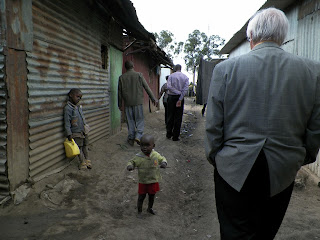
Tuesday afternoon we visited a slum community called KCC. That's short for Kenya Cooperative Creameries, the employer that folded and left the workers without employment, and we had an immediate immersion into slum life in Kenya. But the good news is taht the United Methodists are there as they have a ministry called Panua: Partners in Hope. Panua is the Swahili word for "expand" and they express this UMC related ministry with a focus on orphans who are the eldest sibling caring for the younger children and needing employment and the skills to be self sufficient. In September 2010 the 3 year pilot program began with 160 households representing 470 orphans, children, and youth. They currently focus on empowering 16-22 year old orphans who lead their family. They have levels of training and apprenticing as they take in 70+ new young adults per year with a graduation in 3 years from the program. In addition to mentors they also have peer groups. They see the transformation in this for individual, family, community, and church and desire to expand this model into other cities and UMC churches.
Along the way there were many new understanding of the culture. At one point someone said that in African culture there is a love of visitors as they believe visitors come with gifts! Now this is something of a challenge to international mission as we are trying to get away from an overemphasis on funding and pushing deeper into the giftedness of relationship and partnering. While funds might still be exchanged all parties must learn how and when to do this well as a way of building self sufficiency and sustainability.
Here's KCC:

Other things we heard:
Trinity UMC Naivasha was called "the Vatican" of Kenya UMC and one of the few buildings owned by the conference (could be long discussion here about any UMC church, clergy , or laity in the U.S. that understands the historic "trust clause" and normative accountability of using UMC giving structures versus giving funds, time, or in kind gifts to non-UMC churches or to non-profits, but that may best wait for another blog).

 Kenya UMC District Superintendents meet with North Georgia UMC conference group.


Safari Saturday at the end of the week. Note "safari" is Swahili for "journey." Fun discussion about our safari with Jesus and one another every day no matter where we are!



By the time the whole team cleared the airport, we got the vans in place and loaded up, and made the trip to the Rosa Mystica Spiritual Centre (a Christian guest house run by nuns- simple, nice accommodations with food and very reasonable) and enjoyed a few hours rest prior to breakfast and orientation and worship in their chapel. I enjoyed waking up to a new day with the nuns singing "hallelujahs" at dawn. Then we loaded up the vans and were on our way. Along the journey we stopped at a high viewpoint overlooking the Great Rift Valley. My head was spinning as we thought about the history of the place.
I'm already noticing a certain trend in speech as many, many people are excited for our visit and we often hear the phrase, "Feel at home." The people, the climate, the food, and the opportunities to love God and love Kenyans as we love ourselves make it easy to "feel at home."
During the week we say a number of UMC churches and communities, experienced much of the culture and church life, and began building relationships with this part of the UMC family which has become rather isolated due to episcopal failures in accounting and accountability. I can't share all the stories or insights here (much of that is still "percolating" as I get over the jet lag and return to "normal"), but the team and I were impressed by the calling, the spirit, and the persistence of the churches and their lay and clergy leaders despite all of the challenges. If you are in North Georgia and want to know more I, or one of the team including our leaders of Rev. Tonya Lawrence or Rev. Bernice Kirkland, would be glad to talk with you or your church more about what we experienced.
Tuesday afternoon we visited a slum community called KCC. That's short for Kenya Cooperative Creameries, the employer that folded and left the workers without employment, and we had an immediate immersion into slum life in Kenya. But the good news is taht the United Methodists are there as they have a ministry called Panua: Partners in Hope. Panua is the Swahili word for "expand" and they express this UMC related ministry with a focus on orphans who are the eldest sibling caring for the younger children and needing employment and the skills to be self sufficient. In September 2010 the 3 year pilot program began with 160 households representing 470 orphans, children, and youth. They currently focus on empowering 16-22 year old orphans who lead their family. They have levels of training and apprenticing as they take in 70+ new young adults per year with a graduation in 3 years from the program. In addition to mentors they also have peer groups. They see the transformation in this for individual, family, community, and church and desire to expand this model into other cities and UMC churches.
Along the way there were many new understanding of the culture. At one point someone said that in African culture there is a love of visitors as they believe visitors come with gifts! Now this is something of a challenge to international mission as we are trying to get away from an overemphasis on funding and pushing deeper into the giftedness of relationship and partnering. While funds might still be exchanged all parties must learn how and when to do this well as a way of building self sufficiency and sustainability.
Here's KCC:


Other things we heard:
- the UMC in Kenya is growing, and often growing in the toughest places with folk who are overlooked, are IDP's (Internally Displaced Persons), and are in slum areas.
- the pastors of UMC Kenya are volunteers. They serve churches renting property, receive no income or reimbursements, and are often using their own funds from their paying job/s to help the church with some flow of funds.
- there is a great need for support and the larger connectional church to be an encourager and strategist along with the Kenya UMC as they are finding strong response despite limited resources. We heard of the negative impact of the United States UMC's that support independent churches and non-profits which are not working in coordination with the Kenya UMC. There is confusion and concern why other UMC's -churches, clergy, laity- wouldn't be supportive of the UMC family in Kenya.
- Kenya UMC has focus on what seems to be a hallmark of Methodism in history and current practice around the world- evangelism (outdoor meetings, door to door visiting, visible presence and partnering in community), community development including empowering women, serving children and orphans, emphasis on education including developing schools, and transformational ministries, plus the vibrant worship and focus on discipleship which are necessary for Methodist Christian growth.
- need for more pastoral education and church leadership for laity.
- The majority of pastors can't even travel to annual conference to be ordained (most don't own cars, must take public transportation that may take as long as two days to travel through the 6 countries of the East Africa conference depending on the location, and would also lose the salary of their job while away).
- Since they don't receive church salary they also don't receive any church pension.
Powerful quotes heard during the week:
- "We suffer from those who come for projects and not the church."
- Pastor Moses said, "When people are empowered they can do great things."
- "After the post election violence people fled, and were scattered, but similar to scripture they shared the gospel along the way." "God is able to turn the victim into victor."
- "You have come to walk with us and to work with us."
- "If you miss the way you need to go back to the junction."
- Regarding the impact of Bishop Wandabula's accounting improprieties and the impact upon Kenya UMC as his salary has been reinstated, but the local UMC congregations and ministries still go without any assistance: "You feed the father, but allow the children to die."
- And, "When two bulls fight the grass suffers."
Enough words for now. I'd highly recommend your own personal trip to experience Kenya UMC and learn about the global connection and possibilities of our denomination. Here are a few photos of the week.
Trinity UMC Naivasha was called "the Vatican" of Kenya UMC and one of the few buildings owned by the conference (could be long discussion here about any UMC church, clergy , or laity in the U.S. that understands the historic "trust clause" and normative accountability of using UMC giving structures versus giving funds, time, or in kind gifts to non-UMC churches or to non-profits, but that may best wait for another blog).

 Kenya UMC District Superintendents meet with North Georgia UMC conference group.
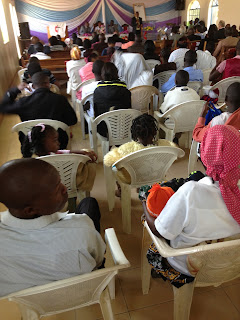
Visiting a church and a few of the members. All of their chairs had been stolen from their simple building. Inside the church we learned more, met with members, sang and prayed.

Another church visit. There were others, but I ran out of batteries and cell phone power on these long days!

Safari Saturday at the end of the week. Note "safari" is Swahili for "journey." Fun discussion about our safari with Jesus and one another every day no matter where we are!


Last Sunday in Kenya, August 16, included worship with Rev. Bernice Kirkland preaching and enjoying Moses translating. Our North GA team also included: Tonya Lawrence, Mike Selleck, Byron & Duwanna Thomas, Darryl Kirkland, JoAn Kinrade, Olu Brown, Robert Saunders, and yours truly. This crew was such a fun, insightful, talented group of individuals that quickly came together as a team. Once again I learned of the power of a team of disciples in following Jesus and how much better, and more effective, and more impactful, that is than an individual, solitary following of Jesus (worthy of another blog as the "lone ranger" way isn't how we can follow Jesus or be the church). Any of this exceptional team can tell you more about their experience in Kenya.


On Sunday we also spent a little time with Deacon Jerioth. She serves the Naivasha District and has responsibility with all of the churches to prepare new church members, prepare people for baptism, prepare people through confirmation, and oversee discipleship.

I was doing what I typically do on such trips, and wandering around taking photos during worship, and standing toward the back of the sanctuary where I could participate in worship while also capturing the story. There was a little boy on the back row, and throughout the worship he kept his eye on me yet with a playful engaging expression. When I took photos or videos he wanted to see! And also help!! I kept pointing him back toward worship as I soon realized that he enjoyed the interactions, but didn't speak any English. He would sing, and dance, and make sure I was doing my job throughout the couple of hours we were in worship. Toward the end of the proceedings, it was now close to 1pm, he went to his mom and got a small crumpled bag that had a couple of pieces of bread. As he walked toward the sanctuary door, and was passing me, he reached into the bag and broke of a good piece of bread. Then he did the unexpected. Instead of feeding himself, he lifted up his handful of bread for me! I said "thank you," and encouraged him to eat it with hand motions even as I gave the sweet boy a hug.
After worship I asked about him and his family and his name. Turns out he's a PK, a pastor's kid, and well known for his sweet disposition and inquiring, engaging nature. Meet my friend Blessing! I hope that you'll get to meet him, and his family, and his extended UMC family sometime soon. You'll find in the relationship more blessings than you can ever imagine! 

Kenya UMC August 2015 Trip, Part 1
I have just returned from an incredible adventure in Kenya as I
experienced the United Methodist Church, and some of the larger Wesleyan family and east African context, there from August 6-16, 2015. It’s an
amazing thing to leave the United States, take a 7 ½ hour red-eye flight to Amsterdam, have a few hours layover
in Europe, then take an 8 ½ hour flight to Nairobi. So, in less than 24 hours
the traveler from Atlanta arrives at 8pm Kenya time after the flight through 7
time zones and touching 3 continents.
That first night was spent at the Methodist Guest House in
Nairobi with the Friday drive to Meru with Mount Kenya and the mountain range in
view. Rev. Gatobu Mathamia picked me up at the airport. Yes, I couldn’t say his
name either! I didn’t know him, nor had his photo, and vice versa. But we
eventually found each other and had a good trip on Friday as we got to know each
other, I fought jetlag while asking many questions, and ate some great food
along the way while also getting an immersion into Kenya traffic and driving. He
also told me about his name. I think I’ve got this order correct (did I mention
I was jet-lagged & Gatobu has a thicker accent- like me- so that it took us
some time to get into synch?!). Gatobu told a story of his birth and that his
grandfather, a shepherd with a large mixed herd of livestock, was taking care
of the animals in the afternoon that Gatobu was born. Gatobu means “shepherd”
in his original language. Muthamia recalls the time when the grandfather's family were migrating
from one location to another and beckons to the family name. Of course, now as
a pastor, Gatobu says he will bring many into the fold and into a new place.
I greatly enjoyed my Friday-Sunday in Meru, about 6 hours
northeast of Nairobi, joining the concluding days of a World Methodist
Evangelism Institute emphasis on evangelism held at Kenya Methodist University.
I’ve heard of their work from years, but have known it more from a US
perspective. What an amazing experience to join the United Methodist, Methodist
Church of Kenya, Nazarenes, Salvation Army, and Free Methodists who had
gathered from Kenya and the region. The sessions included large group lectures,
small group seminars, and 2 outdoor crusades at the nearby town crossroad. We
also experienced an overnight stay with a church family and preaching at their
church.
While at the WMEI training I learned from a “lost boy” of
southern Sudan who lost all of his family, but is now a married adult living in
Kenya and pastoring a UMC church. I heard from a pastor who lives in Somalia
and serves the underground church there. I learned much about the difference between
the MCK, a 100 year old church out of the British Methodist tradition, and the
much younger and under resourced UMC which is only 15 years old. It was said that
while 80% in Kenya say they are Christian that often that is in name only. There
was a lot of discussion about the church moving from being a colonial structure
and approach to being more indigenous and contextually effective. Much of the
discussion was on a mix of big event and relational evangelism which would
reach people and create a momentum. There
was rich discussion about Kenya becoming a mission sending country not only to
reach their own country well, but to also reach the region, and Africa, and the
east African diaspora around the world. I heard stories of a church on the move
as IDP’s, Internally Displaced Persons, have been key to some of the growth of
the church in Kenya and east Africa. I learned much about the outreach and
effectiveness of the UMC in establishing churches in the slums and toughest
places.
The WMEI training was important in the information and
practices which it shared and reinforced with expectation that clergy will
teach and model in their church and community in ways which will help laity and
other church leaders in a region to continue sharing their witness in
contextually powerful ways. I heard repeatedly that a great impact of this
historic event was bringing the Wesleyan family together. Typically they
operate separately, are often in competition, and at times even adversarial in
their approaches. This gathering reinforced that they are all part of one
family and gave plentiful opportunity to interact and know and appreciate one another.
Further, there was exploration of ways they might blend their voices together
for greater impact. Certainly the shared work in music, testimony, and
preaching for the outdoor crusade on Saturday and Sunday afternoons reinforced the
potential to work together in reaching a community.
Some of this experience in conversation and relationships
also exposed the huge contrast between an established century old church with
strong structures, funding, and leadership education with the young UMC congregations
which have experienced 15 years of tough beginnings, 2 episcopal leaders with
significant problems which have isolated the conference from the larger UMC (here's the most recent info on the situation with Bishop Wandabula),
and the challenges in general of developing a UMC conference across 6
countries. UMC pastors aren’t paid by the church, typically work one or more
jobs, have limited education and training in church ministry, and have many
challenges related to daily life. In Kenya UMC alone they have 12 districts, 113 UMC congregations, and only own 5 buildings as it is necessary to rent. Even during the weekend of the WMEI event, one of the UMC churches was kicked out of their rental unit on Saturday afternoon just prior to a visiting preacher and crowd expected on Sunday morning! Imagine having to call all of your congregation with the bad news, struggling to find a location for Sunday, and then needing to call everyone again about the new location. Or consider being the preacher hanging out at a coffee shop on Sunday morning waiting to hear the location where the church will gather and you will preach!
I spent Saturday night in the home of Isaac and his family.
Think of a modest, well kept, cinder block home of a government worker in
community development with two older teens who are interested in pursuing
careers in medicine and two younger children away at a strong elementary school
and you may have the idea. It was a powerful contrast to cross the street on
Sunday morning and visit with Isaac’s elderly parents who live on a farm and
live in an older style compound that seems typical in Kenya and much of Africa.
I preached at Mathangane MKC on Sunday morning where Isaac is chairman of the board.
They had almost 80 children in the Sunday School and around 200 in worship. We
enjoyed some of the milk tea prior to worship, started worship around 10:15am,
and concluded a little after 1pm. While the clergy and worship leaders slipped
off into a room for lunch the laity continued meeting on some matters of
interest and importance.

Now, this WMEI experience was strong in information and
conversation, but the actual practice of having an outdoor crusade was powerful.
Imagine the setting at a crossroads with all of the traffic, with marketplace
and stalls lining the streets, with many people walking and riding and passing
through. Now think of an outdoor worship that has intention of getting your
attention, causing you to stop and check it out, and inviting your notice and
participation. Think of outdoor crusade as spectacle and invitation. Think of
music that invites you to join in with the singing and dancing. This is worship
in the pubic square which expresses power and transformation. Visualize prayer
and healing for the people of the community and for yourself. This is also a
chance to make visible claims in the center of the village about who you are
and the God you serve.


This is just a quick snapshot of my Friday-Sunday (August 7-9) experience
in Kenya!
Subscribe to:
Posts (Atom)